
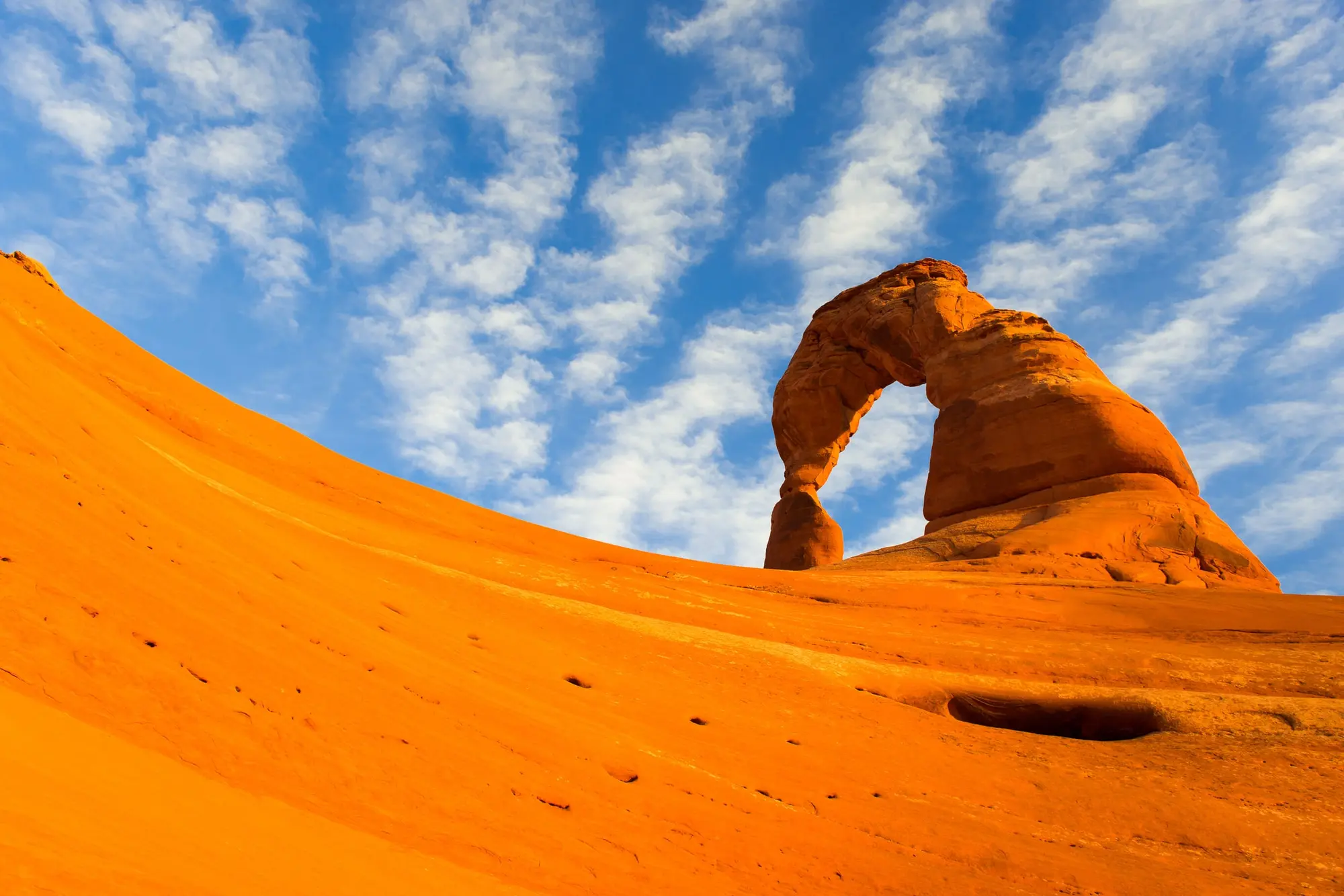

Moab is about 345 miles from Zion Canyon, five to six hours by I-15 and I-70, and it puts two more national parks close to one town. The entrance to Arches is 5 miles north of Moab, and Canyonlands’ Island in the Sky about 32 miles away. In 2026 Arches needs no timed-entry reservation, though the Fiery Furnace inside it still needs a permit, and neither Arches nor Canyonlands charges the $100 nonresident fee that Zion and Bryce Canyon do. The tours worth booking in Moab are the ones a rental car cannot do: the slickrock of Hell’s Revenge, the backcountry roads of the two parks, and the Colorado River.
The tours, compared
As listed on Viator on 1 November 2026. All four start in Moab, so from Zion you drive there yourself.
| Tour | Where it starts | What you do | Price |
|---|---|---|---|
| Moab Tourism Center, Hell’s Revenge U-Drive | Its office at 606 South Main Street. Arrive 15 minutes before | Drive a four-seat UTV behind a guide over the slickrock of Hell’s Revenge, 3 hours | $101.25 a person on the morning tour (to 30 November, then from 12 March 2027), $135 an adult at sunset (to 29 November, then from 1 March), $130 an adult at 12:15 p.m. (from 12 February). Two people at least in each UTV |
| Adrift Adventures, Arches backcountry 4x4 | Its office at 378 North Main Street, 7 a.m. or 12:30 p.m. | A guide drives you into Arches by an unpaved back way, 4 hours 30 minutes | $210 an adult, $200 ages 4 to 15 |
| Adrift Adventures, Canyonlands backcountry 4x4 | The same office and times | Island in the Sky, then down the switchbacks of the Shafer Trail, 4 hours | $210 an adult, $200 ages 4 to 15 |
| Mild to Wild Rafting and Jeep Tours, Colorado River half day | Its Moab office, 1:30 p.m. | Two hours on the river by Castle Valley, with Class II rapids; 4 hours in all | $109.91 an adult, $88.11 ages 4 to 13. Nothing on sale before 13 March 2027 |
If you book one thing in Moab, make it Hell’s Revenge. You drive a four-seat Kawasaki UTV yourself, behind a guide, up and down the sandstone fins and ledges of Hell’s Revenge, with a stop at fossil dinosaur tracks near Lion’s Back. Moab Tourism Center, a tour company despite its name, runs it in groups of up to 23, and the tour is rated 5.0 from 3,512 reviews. Drivers must be 21 with a license, each UTV carries two people at least, and closed-toe shoes are required. The $89.20 at the top of its listing is a passenger seat in the guide’s UTV, and no date is on sale for it. To drive your own it is $101.25 a person on the morning tour, which runs to 30 November and again from 12 March 2027; $135 an adult on the sunset tour, to 29 November and again from 1 March; and $130 an adult at 12:15 p.m., a tour that starts again on 12 February. No date is on sale from 1 December to 11 February.
For Arches beyond the paved road, Adrift Adventures’ backcountry 4x4. A guide drives you, in a Jeep Wrangler with four passenger seats, into the park by an unpaved route off US-191 north of Moab, to places that may include Eye of the Whale, Tower Arch and Sand Dune Arch, and out past Balanced Rock, the Windows and Park Avenue. It is $210 an adult and $200 for ages 4 to 15, rated 4.9 from 653 reviews. Adrift’s Canyonlands tour is the same price, rated 4.9 from 519: up to Island in the Sky and down the switchbacks of the Shafer Trail, part of the White Rim Road. Both leave Adrift’s office at 7 a.m. or 12:30 p.m. and stop selling 24 hours ahead, and Adrift asks you to call the day before to reconfirm. Neither has a date on sale from 13 December to 14 February, except the Canyonlands tour on 5 and 6 February.
On the river, Mild to Wild’s afternoon half day. Two hours on the Colorado through the red-rock canyon by Castle Valley, with a few Class II rapids between the flat stretches, for $109.91 an adult and $88.11 for ages 4 to 13. The shuttle to the river and back, the life jackets and the river and land access fees are included, and it is rated 4.9 from 781 reviews. No trip is on sale before 13 March 2027, when its 2027 season starts; that season runs to 7 November.
All four can be canceled free up to 24 hours ahead. Adrift and Mild to Wild may cancel a trip that too few people have booked, and then offer another or a full refund.
The drive: three ways from Zion to Moab
From the Zion Canyon Visitor Center to the center of Moab, by two OpenStreetMap routers, OSRM and Valhalla, on 20 October 2026, without stops.
| Route | Distance | Driving time | The way |
|---|---|---|---|
| I-15 and I-70 | 345 miles | 5 hours 20 minutes to 5 hours 56 minutes | Highway 9 west to I-15, north to I-70 at Cove Fort, east past Salina and Green River, then US-191 south at Crescent Junction. The routers’ choice |
| The tunnel and US-89 | 326 to 331 miles | 5 hours 46 minutes to 6 hours 23 minutes | Highway 9 east through the Zion-Mount Carmel tunnel, US-89 north to I-70, then as above. Shorter, and slower |
| Bryce Canyon and Capitol Reef | 354 to 356 miles | 7 hours 14 minutes to 8 hours 11 minutes | Through the tunnel, US-89 and Utah 12 past Bryce Canyon, over Boulder Mountain to Torrey, then Utah 24 through Capitol Reef to I-70 |
Plan on six hours by I-15 and I-70, plus your stops. It is the fastest way and the one that skips the Zion-Mount Carmel tunnel, so it is the way for a vehicle over the tunnel’s size limits. US-191 leaves I-70 at Crescent Junction and runs 22 miles south to the entrance to Arches, then 5 more into Moab.
The scenic way is a two-day drive. The Park Service puts Bryce Canyon to Capitol Reef at about three hours on Utah 12, a 123-mile highway from US-89 near Panguitch to Torrey through much of Grand Staircase-Escalante National Monument; the routers give 124 to 126 miles between the two visitor centers, 2 hours 41 minutes to 3 hours 8 minutes. Zion Canyon to Bryce’s visitor center is 85 miles, 1 hour 49 minutes to 2 hours 10 minutes, and Capitol Reef’s visitor center to Moab 145 miles, 2 hours 44 minutes to 2 hours 53 minutes, about 81 of them on Utah 24 by the Park Service’s directions. With time at either park, it needs a night on the way.
Winter on the high roads. Utah 12 tops out at 9,600 feet on Boulder Mountain, and the Park Service calls it hazardous to drive in winter. UDOT watches Boulder Summit as one of the state’s mountain passes, and I-70 crosses three more over 7,000 feet: Clear Creek Summit, Salina Summit and Ghost Rock Summit. None of these roads closes for the season; the highways UDOT shuts each winter, typically from November to May or June, are nine others. In winter, check UDOT’s road conditions and cameras before you set off, as the Park Service advises.
Summer storms on Utah 24. Utah 24 follows the Fremont River through Capitol Reef, and the park’s alert for the monsoon season warns that heavy rain can cause sudden flooding, especially in canyons and washes, that some roads may close for a time, and that closures are posted at the visitor center. Do not drive into water across a road.
Getting home. From Moab back to the Las Vegas Strip is about 462 miles, 6 hours 56 minutes to 7 hours 48 minutes by the same routers. Salt Lake City’s airport is 237 miles from Moab by the Park Service’s figure, and Canyonlands Field (CNY) 16 miles.
The clock does not change. Moab is in Utah, on Zion’s clock all year, so unlike Page or the Grand Canyon from March to early November, there is no hour to gain or lose.
Arches: no reservation in 2026, and nothing set for 2027
In 2026 you can drive into Arches at any hour without a reservation. The Park Service announced on 18 February 2026 that the park would not require timed-entry reservations this year, and Arches is open 24 hours a day, all year. You still need an entrance pass, sold at the entrance station, by card only, or online at Recreation.gov, and reservations are still required for Devils Garden Campground and for the Fiery Furnace.
No reservation does not mean no wait. From March to October the Park Service warns that the wait at the entrance can last up to an hour, and once the parking lots fill — Devils Garden, Delicate Arch and the Windows are usually full for much of the day — it can close the entrance to new cars for three to five hours, and you may not park near the entrance sign or anywhere along the road to wait. In summer many trailhead lots fill by 7:30 a.m. Go early or late: the park is open around the clock, and it is an International Dark Sky Park. There is no gas inside.
The free shuttle has stopped for the year. From 1 September to 31 October 2026 the Moab-Arches Shuttle, which the park’s home page points to, ran every 30 minutes from downtown Moab to the Arches Visitor Center, daily from 8 a.m. to 5 p.m., and every 15 minutes from there to the Delicate Arch and Windows trailheads, 8 a.m. to 4 p.m.; the last bus left Delicate Arch at 4:05 p.m. It was free, but you showed a valid Arches or America the Beautiful pass to board, and a standard vehicle pass covered a party riding together. It is a pilot, due back in spring 2027: from 1 March to 30 June by Moab’s tourism office, and from mid-March to mid-June by Grand County’s signed agreement with the Park Service, which also lets the season move.
2027. As of 1 November 2026 the Park Service has set no entry rule for 2027. Its February announcement covered 2026, and its national statement the same day said parks without timed entry would watch traffic and could add measures if conditions warrant. Arches ran timed-entry pilots every season from 2022 to 2025, and its long-term plan, the Visitor Access and Experience Plan released in draft in October 2024, favors a single park-wide timed-entry system. The park took about 150 comments on it, and the plan’s page, last updated in February 2026, says they are being analyzed. If you are planning for spring 2027, read the park’s Plan Your Visit page before you fix your dates.
The Fiery Furnace still needs a permit. It is a maze of narrow passages between towering sandstone walls, and the only ways in are with a ranger or on a self-guided permit, both from Recreation.gov. A ranger-led hike is $16 a person, booked up to seven days ahead, and runs spring through fall. A self-guided permit is $10 a person, booked two to seven days ahead, for a group of six at most. Either way you pick it up the day before or the day of; a self-guided permit is picked up at the Arches Visitor Center, where the whole party watches a required video, at 8, 8:30, 9, 9:30 or 10 a.m., or 2, 2:30, 3 or 3:30 p.m. No children under 5 may go, no pets may go on a self-guided permit, and no commercial group may enter, so none of the tours here goes in. On Recreation.gov on 1 November 2026 the ranger-led hikes had ended for the year, the last on 24 October. Self-guided permits were scheduled every day to 30 November, each day’s released at 8 a.m. Mountain Time a week ahead, with every one for 6 and 7 November taken and none yet listed for December.
Canyonlands: four districts, and no road between them
Canyonlands is four districts divided by the Green and Colorado rivers, and no road links them inside the park: the Park Service puts the drive from one to another at two to six hours. From Moab:
- Island in the Sky is the close one, and the easiest to see in a short visit: a mesa more than 1,000 feet above the land around it, with overlooks along a paved scenic drive. It is 10 miles north of Moab on US-191, then 22 miles on Utah 313; the Park Service says about 40 minutes to the visitor center, and the routers 47 to 54 minutes for 32.5 miles. The visitor center is open all year, with some closed days in winter.
- The Needles, the park’s southeast corner, named for its spires of Cedar Mesa Sandstone, is more of a backcountry district: you hike or drive four-wheel-drive roads to its sights. It is 40 miles south of Moab on US-191, then about 35 miles west on Utah 211, the only paved road in; 74 miles, and 1 hour 35 minutes to 1 hour 43 minutes, by the routers.
- The Maze is the remote one. Only unpaved roads reach it, graded dirt or high-clearance four-wheel drive, and it takes considerably more time and self-reliance.
- The rivers are the fourth: flatwater trips on the Green and Colorado, and whitewater in Cataract Canyon.
The White Rim Road is open again after October’s rains, with a warning. The 100-mile road that loops below Island in the Sky was closed on its western side, from Mineral Bottom to west of White Crack Junction, from 15 October 2026, after rains left rockfall, washouts, mud and standing water. On 20 October the park’s road report listed the White Rim Road and the Mineral Bottom road open, and by that evening the closure was gone from the Park Service’s alerts. The report’s Island in the Sky entry, updated on 24 October, still says travel on the road’s west side is not advised because of muddy, slick conditions, and it does not recommend the Mineral Bottom road either; the park’s alerts now carry the same caution, that the Mineral Bottom switchbacks and the west side are passable but slippery and muddy, and not recommended until they dry out. Expect mud and slick, narrow stretches on Hardscrabble Hill after heavy rain, when mud and quicksand can make Upheaval Wash impassable. Every trip needs a day-use or overnight White Rim permit, and a car or truck must be a high-clearance four-wheel drive with low range. Mountain bikes, e-bikes and road-licensed motorbikes are allowed too; ATVs and UTVs are not, even street-legal ones. The Colorado River Overlook Road in The Needles, closed by the same rains, is still listed as impassable in the report’s Needles entry, updated on 24 October.
Canyonlands needs no timed-entry reservation either. A vehicle over 25 feet long has trouble there: at Island in the Sky it can park at the visitor center, Shafer Canyon Overlook, Grand View Point and Green River Overlook.
The fees: $30 a car, and no $100 nonresident fee
Arches and Canyonlands each charge $30 a car, $25 for a motorcycle and $15 a person on foot or by bicycle (16 and over), by card at the entrance stations. A $55 annual pass, sold to US residents, covers both parks and Natural Bridges and Hovenweep national monuments.
Neither charges the $100 nonresident fee. The Park Service charges non-US residents aged 16 and over $100 a person at 11 parks, Zion and Bryce Canyon among them, but not at Arches, Canyonlands or Capitol Reef. Capitol Reef charges $20 a car for its Scenic Drive, at a self-pay station on that road just south of the campground, not on Utah 24.
The scenic way, with a stop at each park:
| Two adults in one car | At the gates | With an annual pass |
|---|---|---|
| US residents | $35 at Zion, $35 at Bryce Canyon, $20 for Capitol Reef’s Scenic Drive, $30 each at Arches and Canyonlands: $150 | $80, the America the Beautiful pass |
| Non-US residents, 16 and over | The same, plus $200 at Zion and $200 at Bryce Canyon: $550 | $250, the Non-Resident Annual Pass |
Any valid annual pass covers the entrance fee and the nonresident fee for everyone in the holder’s car. The rest of the arithmetic is on the fee page.
Heat and flash floods
Spring and fall are the seasons; summer often passes 100°F. At Arches, spring (April and May) and fall (mid-September through October) bring daytime highs averaging 60 to 80°F. July’s highs average 100°F, with 16 days over 100, and August’s 97°F, with 12; June has 6. The Park Service asks hikers to carry 2 to 3 liters of water each even on front-country trails, and in summer hikers beating the heat fill trailhead lots before 8 a.m. Winter highs average 30 to 50°F, and a little snow or ice can make trails and roads impassable.
Late summer is flash-flood season. The Park Service’s weather pages for Arches and Canyonlands warn that late-summer monsoon storms often cause flash floods, and Arches’ adds that roads can close after rain or snow. A flood can come down a wash under a sunny sky, and 6 inches of water can knock you off your feet: stay out of washes when storms are about, and turn back from water across a road. October’s rains closed the western side of Canyonlands’ White Rim Road for most of a week, and the Colorado River Overlook Road in The Needles (above). How the monsoon works around Zion is on the flash-flood page.
Bryce, and the tunnel, on the way
The scenic way passes Bryce Canyon, 85 miles from Zion Canyon, and the Zion and Bryce page has where to stay between the two and what each park charges. Both routes east of Zion start through the Zion-Mount Carmel tunnel, inside the park, so you need your Zion pass: the size limits, UDOT’s work on Highway 9 and the road’s state today are on the tunnel page. A vehicle over the limits goes by I-15 and I-70.
Booking
The four tours below, read on Viator on 1 November 2026, are the ones in the comparison above. All four start in Moab, on Zion’s clock, and all can be canceled free up to 24 hours before they start.


