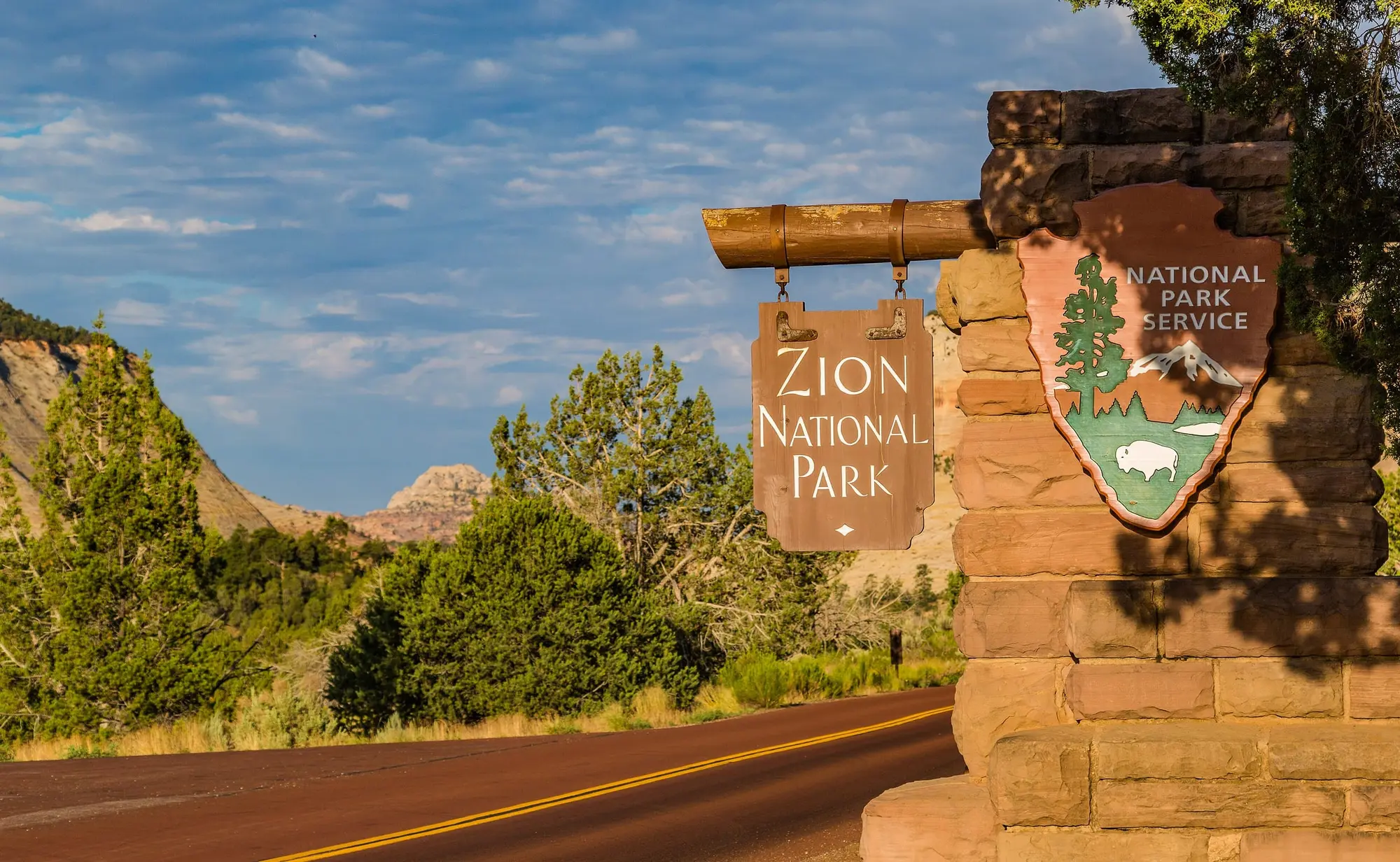
Zion’s entrance fee is $35 and takes thirty seconds to pay. The thing worth reading this page for is the surcharge underneath it.
What a pass costs
| Pass | Price | Valid |
|---|---|---|
| Private vehicle | $35 | 7 days |
| Motorcycle | $30 | 7 days |
| Per person, on foot or by bike, 16+ | $20 | 7 days |
| Snowmobile | $20 | 7 days |
| Zion annual | $70 | 12 months from purchase. US citizens and residents only |
| America the Beautiful, resident annual | $80 | 12 months, every federal site. US citizens and residents only |
| America the Beautiful, non-resident annual | $250 | 12 months. The tier a non-US resident actually buys |
Passes are sold at any entrance station, and buying ahead through recreation.gov is worth it in season purely for the time at the gate. What a pass does not buy you is a way up Zion Canyon: for most of the year that is the free park shuttle, and the Zion shuttle guide has the stops, the first and last buses and the holiday week.
The $100 nonresident fee
The Park Service states it directly:
Each non-US resident aged 16 and older visiting Zion National Park must pay a $100 nonresident fee (in addition to the standard entrance fee), unless admitted with an Annual or America the Beautiful Pass.
That last clause is the whole thing, and it is wider than it looks.
A pass covers everyone in the car. The Park Service’s rule is that any valid America the Beautiful or park annual pass covers the entrance and nonresident fees for the pass holder and the passengers in a private vehicle. So a car driven by a US resident with an annual pass pays no $100 for the foreign visitors riding with them. Where the fee is charged per person — walking or cycling in — a pass covers the holder and three more adults.
Children are free. The fee applies from age 16, and the park admits anyone 15 and under free, so two non-resident adults and two children in one car pay $35 plus $200, not $35 plus $400.
Check which pass before you buy one. The $80 America the Beautiful annual is sold only to US citizens and residents. The version a non-US resident can buy is the $250 non-resident annual, and that changes the answer:
| Two non-US residents in one car | At the gate | With the $250 pass |
|---|---|---|
| Zion only | $35 + $100 + $100 = $235 | $250 |
| Zion and one more surcharge park | $470 | $250 |
So the pass is not automatically the cheaper option. For a single park it loses by $15. It wins decisively the moment you visit a second park on the list, because it waives the $100 each time as well as the entrance fee.
The surcharge is not service-wide. It applies to eleven named parks: Acadia, Bryce Canyon, Everglades, Glacier, Grand Canyon, Grand Teton, Rocky Mountain, Sequoia & Kings Canyon, Yellowstone, Yosemite and Zion. At any other national park a non-US resident pays the ordinary entrance fee and nothing more, which is the whole reason the two-park arithmetic above matters.
Zion takes cash. Not every park does
The Park Service says card payment is preferred at Zion but that cash is also accepted.
That is worth stating because it is exactly the kind of fact that gets flattened into a general rule and then gets someone turned away. Acadia stopped accepting cash entirely on 15 April. Two national parks, opposite answers, same year. Check the park you are actually going to.
Angels Landing is separate
The Angels Landing permit is not part of your entrance pass. It is a separate lottery: $6 to apply, covering up to six people, and $3 per person if you win. The $6 is never refunded.
The permit is the harder problem of the two, and the seasonal and day-before lotteries work differently — that is its own page.
Fee-free days
The Park Service’s 2026 list has ten fee-free days, Zion included: 16 February, 25 May, 14 June, 3–5 July, 25 August, 17 September, 27 October and 11 November. The next two are 27 October and 11 November; what else changes around them — the shuttle’s shorter hours, the winter lottery — is on the October and November page.
They are not free for everyone. From 2026 the Park Service limits fee-free entrance to US citizens and residents; non-residents pay the regular entrance fee and any applicable nonresident fee. If you are visiting from abroad, a fee-free day saves you nothing and costs you the crowd.
A fee-free day saves a carful $35. It does not make the shuttle less full, it does not produce an Angels Landing permit, and in July it makes the canyon busier. It is a saving, not a strategy.