
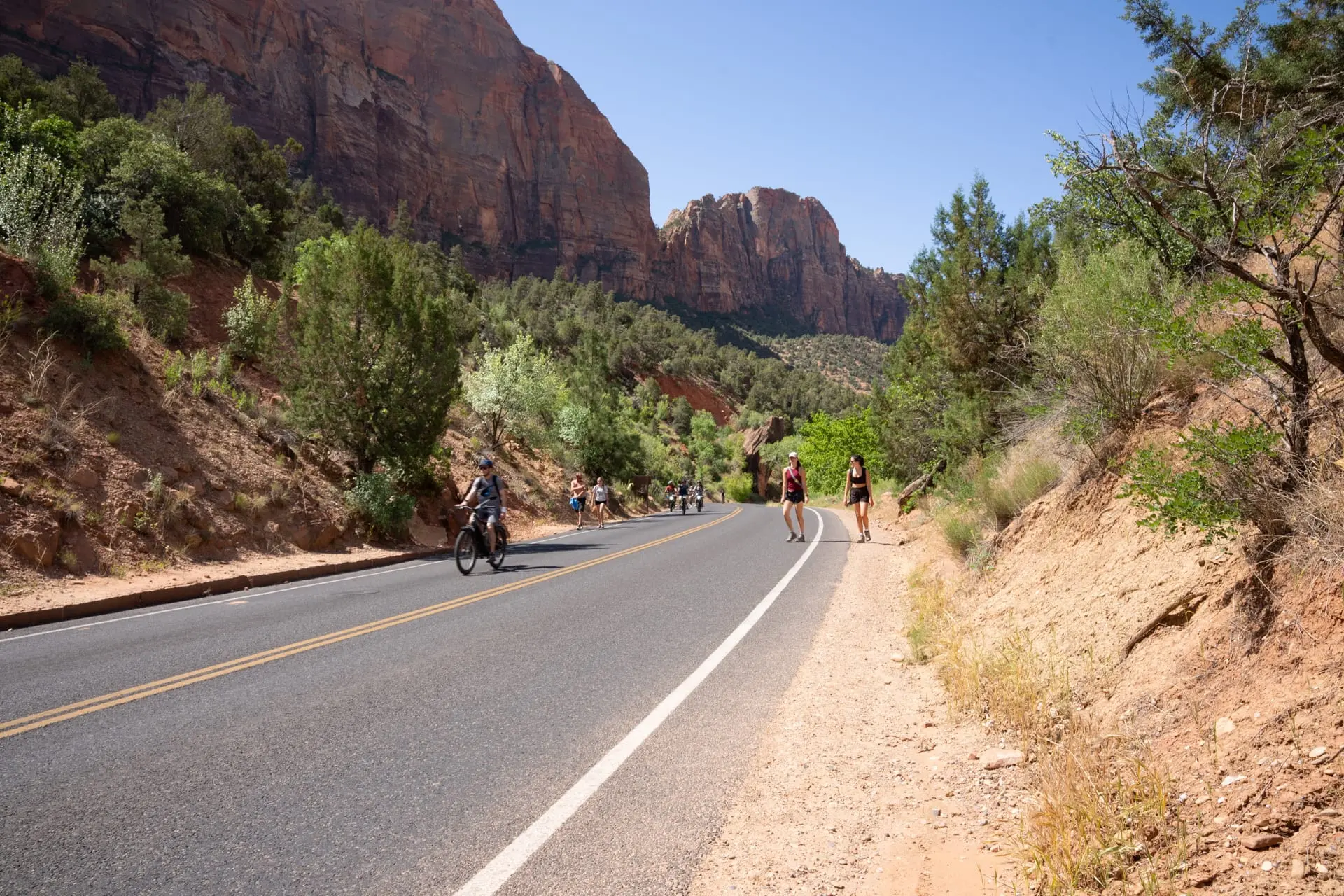
A bicycle is the one vehicle that ignores everything difficult about Zion. No shuttle line, no parking lot at 8 a.m., no private-vehicle ban on the Scenic Drive. It is genuinely the best way to see the canyon.
There is one rule that decides which bike you should be on, and most rental listings do not mention it.
Biking Zion, in short
- Where: the Pa’rus Trail and the park’s paved roads, the Scenic Drive included, all year. While the shuttle runs, from about March to 28 November and again from 26 December to 2 January, that road is closed to private cars, so a bike shares it mostly with the buses. Every other trail is closed to bikes, and so is the tunnel.
- Which e-bike: Class 1 pedal-assist only, cutting out at 20 mph.
- The catch: e-bikes are not allowed on the shuttle buses, so an e-bike rides the canyon both ways.
- What it costs: in Springdale an e-bike is $59 for 2.5 hours at Zion Guru or $65 for 4 hours at Zion Adventure Company, and a full day starts at $79 to $95 at Zion Outfitter, Zion Guru and Zion Adventure Company; a regular bike is $29 to $39 a day at Zion Outfitter. Zion Adventure Company’s two rentals are linked below, with a guided e-bike ride of three to four hours from $135 a person.
The e-bike rule that doubles your ride
E-bikes are not allowed on the park shuttle buses, and they do not fit the racks on the front either. The Park Service’s advice is to plan on riding the Scenic Drive both ways.
On a regular bike, the standard plan works: ride up the canyon, get tired, put the bike on a shuttle rack, ride the bus back. You load it yourself, and no fat-tire bikes: the Park Service’s shuttle page bars them as well as e-bikes. How many bikes a rack takes depends on which Park Service page you read: its bicycling page says two, its shuttle page three, and Zion Outfitter says three too. Either way it is a handful, and Zion Outfitter warns that a larger group may have to split up and wait for the next bus.
On an e-bike, that escape hatch does not exist. You ride back. The motor makes the outbound easy, which is exactly why people underestimate the return trip and how much battery it needs.
This is not an argument against e-bikes — the Scenic Drive is about 8 miles each way and the assistance is welcome. It is an argument for knowing it before you book, and for a guided ride that handles the logistics if you would rather not think about range.
Which e-bikes are allowed
Only Class 1 pedal-assist e-bikes are allowed in the park: the motor must supply less than half the power, must not work unless you are pedaling, and must stop assisting at 20 mph. Anything faster is not allowed. So: pedal-assist only, no throttle, cuts out at 20 mph. A Class 2 or Class 3 bike from home is not legal here. Anything you rent in Springdale will be compliant; anything you bring might not be.
Where you can and cannot ride
Bikes are allowed on the Pa’rus Trail and the park roads, and nowhere else: every other trail and off-trail route is closed to them, and so is the Zion-Mount Carmel Tunnel.
The tunnel is a hard no, and the only way through it is startling:
The 1.1-mile tunnel has no lights, and parts of it are completely dark. A cyclist has to get a ride through it on a vehicle — the park’s own note is that this is often possible by hitchhiking — and rangers are not allowed to carry cyclists through or arrange a ride.
If you are riding to the east side — to Canyon Overlook, say — your plan has to include a stranger with a pickup. And note that hitchhiking is itself regulated here: “hitchhiking is allowed only in established roadside pullouts.” When the highway is closed there is no such ride to be had, as from 30 September to 9 October 2026, when a rockfall closed it to through traffic from Canyon Junction to the East Entrance. The Scenic Drive and the Pa’rus Trail are not affected either way.
Beyond the tunnel, the road gains 900 feet in just under three miles. The tunnel’s other rules and its current construction closures are on the tunnel page.
The road rules that are actually rules
- Yield to buses, by stopping. “When a shuttle bus is behind a cyclist, the cyclist must pull over to the side of the road and come to a complete stop. Allow the bus to safely pass before riding.” And: “Never pass a moving bus.”
- Groups of six maximum. “Cyclists are limited to groups of 6 bikes or less. Please split up larger groups.”
- Helmets are mandatory under 18, and sensible over it.
- 15 mph speed limit on the Pa’rus Trail.
What the ride is actually like
The Scenic Drive is not flat. The first two miles are steep; after the Court of the Patriarchs the road levels out; and there is a significant uphill grade southbound between Weeping Rock and the Grotto. Read that last one twice. The southbound grade is on your way back, between Weeping Rock and the Grotto, at the point in the day when you are least interested in a climb.
Two free repair stations
There are two, at Canyon Junction (shuttle stop 3) and the Grotto (stop 6), each with an air pump, a screwdriver, wrenches and a hands-free bike mount. Worth knowing where they are before you need one.
How long is the Pa’rus Trail? 1.6 miles each way
The Park Service’s survey, assessed on 13 January 2025, puts it at 1.6 miles (2.5 km) one way, from the Visitor Center to Canyon Junction. Three of its pages print three figures, and they fit together once you see what each one is measuring:
| Source | Length |
|---|---|
| NPS Bicycling page | “1.75 miles from Zion Canyon Visitor Center to Canyon Junction” |
| NPS Pa’rus Trail page, body text | “3.5 mile (5.6 km) from one end to the other” |
| NPS Pa’rus Trail page, accessibility block | “Length (one way) 1.6 mi (2.5 km)” |
The 3.5 is the round trip: the park’s printed Information Guide lists the Pa’rus at 3.5 miles in its round-trip column, with two hours and 50 feet of elevation change. The bicycling page’s 1.75 is a one-way figure a little longer than the survey’s. Plan on about 1.6 to 1.75 miles each way, 3.5 there and back.
The Pa’rus matters more than its length suggests: it is paved, it is the only trail in the park that allows bikes, and it is the connection from the Visitor Center to Canyon Junction without riding on the road.
Getting in
The bicycle entrance is in Springdale, next to Zion Outfitter and the Zion Brew Pub, where a small bridge crosses to the pedestrian fee station and joins the Pa’rus. You still pay the entrance fee — the fee page covers what it costs on a bike — but you skip the vehicle line entirely, which in April is worth more than the money.
Zion e-bike rentals: what the Springdale shops charge
Three of the Springdale shops that rent e-bikes for the Scenic Drive price them three different ways: a flat day rate, blocks of hours, and packages. Before tax, as of 13 October 2026, and Zion Adventure Company’s as of 30 October:
| Shop | E-bike | Regular bike | Who can ride |
|---|---|---|---|
| Zion Outfitter, 7 Zion Park Blvd, beside the pedestrian and bicycle entrance | $79 a day, flat | $39 a day picked up before noon, $29 after | E-bikes 14 and up, single rider |
| Zion Guru, 1013 Zion Park Blvd | $59 for 2.5 hours, $79 for 4, $89 for a full day | None | Single-rider e-bike 12 and up; a two-rider bike for an adult and a small passenger |
| Zion Adventure Company, 36 Lion Blvd | $65 for 4 hours, $95 a day, or $115 a day with Narrows gear in warm weather, $140 in cold | None | Kids’ e-bikes, and an e-bike with a passenger seat from $115 |
Zion Outfitter’s e-bikes are for riders 14 and up, one rider per bike, card payment only, helmets included; reserved e-bikes must be picked up by 10 a.m., and everything is due back an hour before the shop closes. There is no discount for extra days, no trailers or child seats on its e-bikes, and holiday weekends are first come, first served.
Zion Adventure Company’s bikes are ready when it opens at 8 a.m. and due back by 7:30 p.m., with an early pickup for 10% more; the shop itself closes at 7 p.m. in November and 6 p.m. from December to February, so plan to be back before it closes then. Its full day and its four-hour half day are linked below, and sales tax and fees add about 14% at checkout. Its standard e-bikes come with a helmet, a lock, a basket and a holder for a Narrows walking stick, the reason for its e-bike-and-Narrows-gear package. Its kids’ e-bikes come without the basket and the holder, and its e-bike with a passenger seat comes with helmets and a lock.
Zion Lodge rents e-bikes too, to its own guests, from the Lodge itself, so a guest can ride straight up the canyon from stop 5: $105 for a full day, before about 12% in tax and fees, on a single-rider or family e-bike, back by 8 p.m., linked below. The Lodge says availability is extremely limited.
Zion Guru e-bikes
Zion Guru rents Rad Power and Lectric e-bikes from its shop on Zion Park Boulevard: the Rad Runner for a single rider aged 12 and up, a compact bike for smaller riders at the same prices, and the Rad Wagon, for one adult and a small passenger, at $69 for 2.5 hours, $99 for 4 and $109 for a full day. A child trailer is $30 and an infant seat $10. Its full day is 8 hours or more on its price list and 9 hours in its rental terms; afternoon half days and the 2.5-hour rides are walk-in only. On top of the rate go 8.38% sales tax and a $7 damage waiver on every bike.
For a dawn start it offers early pickup, late drop-off or overnight access for $15 a bike: you come to the shop between 5 and 7 p.m. the evening before for an orientation and a test ride, then lock the bikes in its early-access area for the morning or, if you are staying in Springdale, ride them back to your hotel.
Zion Guru also guides a 4-hour e-bike tour of the Pa’rus Trail and the Scenic Drive, priced by group size: $420 for one rider, $228 each for two, falling to $122 each for twelve, plus sales tax and fees, with groups split into sixes on the road.
Our honest recommendation
If you are reasonably fit, rent a regular bike, not a fat-tire one. You get the shuttle rack as a bailout and the canyon is not a hard ride.
If you want to cover more ground, or the grade worries you, take the e-bike and plan both directions. That is a 16-mile round trip with assistance, which is comfortable for most people and completely miserable if the battery dies at Temple of Sinawava.
If you would rather someone else solved the routing, the battery and the permit-free logistics, that is what the guided ride below is for.


